Friday, December 31, 2010

Algorithm for Emergency Management of Complicated STEMI

STEMI = ST-elevation myocardial; IV = intravenous; SL = sublingual; SBP = systolic blood pressure; BP = blood pressure; ACE = angiotensin converting enzyme

Labels:

Thursday, December 30, 2010

Algorithm of the cause of Hypokalaemia

A history of vomiting, diarrhoea, or use of medications such as diuretics can be helpful in determining the cause of hypokalaemia. However, in some cases, the cause of hypokalaemia is not readily apparent. In these cases, measurements of BP and urinary potassium excretion, and assessment of acid-base balance are often helpful.

Serum potassium concentrations:
There is no strict correlation between the serum potassium concentration and total body potassium stores. In chronic hypokalaemia, a potassium deficit of 200 to 400 mmol (200 to 400 mEq) is required to lower the serum potassium concentration by 1 mmol/L (1 mEq/L). These estimates are good provided there is no concurrent acid-base abnormality (e.g., for diabetic ketoacidosis or severe non-ketotic hyperglycaemia).

In diabetic ketoacidosis patients may have a normal or even elevated serum potassium concentration at presentation, despite having a marked potassium deficit due to urinary and GI losses.

Spurious hypokalaemia can occur when blood with a high WBC count is left at room temperature due to extraction of potassium by the WBCs. It is therefore important to consider repeating the test for confirmation.

Labels: ,

Wednesday, December 29, 2010

Assessment of Head injuries in children

Perform a primary survey and ensure that the child’s airway, cervical spine, breathing and circulation are secure.

Rapidly assess the child’s mental state using the AVPU scale. Use firm supraorbital pressure as the painful stimulus.

* A Alert
* V Responds to voice
* P Responds to pain
----> Purposefully
----> Non-purposefully :
  •  Withdrawal/flexor response
  •  Extensor response
* U Unresponsive
Assess pupil size, equality and reactivity and look for other focal neurological signs.
Perform a secondary survey looking specifically at:

* Neck and cervical spine – deformity, tenderness, muscle spasm
* Head – scalp bruising, lacerations, swelling, tenderness, bruising behind the ear (Battles sign)
* Eyes – pupil size, equality and reactivity, fundoscopy
* Ears – blood behind the ear drum, CSF leak
* Nose – deformity, swelling, bleeding, CSF leak
* Mouth –dental trauma, soft tissue injuries
* Facial fractures
* Motor function – examine limbs for presence of reflexes and any lateralising weakness
* Perform a formal Glasgow Coma Score
* Consider the possibility of non-accidental injury during secondary survey especially in infants with head injury.
* Other injuries (see major trauma guidelines)

Labels: , ,

Tuesday, December 28, 2010

Ambulation Algorithm


FOOTNOTES:
1. Non-weight bearing: Patient is unable to bear weight through both lower extremities or weight-bearing through both lower extremities is contraindicated.

2.
Partial weight bearing: This will include situations where the patient may be allowed: a) Limited weight bearing on one lower extremity and full weight bearing on the other extremity; b) Partial weight bearing through both lower extremities.

3.
Safety risks may include: decreased cognition; decreased ability to cooperate/ combativeness; medical stability.

4.
Factors that contribute to low safety risk: a) Lack of combativeness; b) Ability to follow commands; c) Medical stability; d) Experience with the assistive device.

5.
Factors that contribute to high safety risk: a) Combativeness; b) Lack of ability to follow commands; c) Medical instability; d) Lack of experience with
the assistive device, e) neurological deficits.

Labels: ,

Thursday, December 16, 2010

BLUNT ABDOMINAL TRAUMA(Surgery algorithm)

Friday, December 10, 2010

Diagnostic Algorithm for Evaluation of Acute Myelopathies and Myelitis.


Click on photo for enlargment

Labels: ,

Sunday, November 21, 2010

USMLE ALGORITHMS: Cushing Syndrome

This video explains the complete workup of Cushing Syndrome, the causes, the diagnosis, and the full management. It is very thorough. I hope you enjoy

Labels: ,

Monday, November 15, 2010

Clinical Approach to Metabolic Alkalosis

History
Obtain historical data to pinpoint the nature of the disease causing metabolic alkalosis.

* Ask the patient about history of vomiting, other gastric fluid loss, and diuretic use. Loss of gastric fluid and HCl due to ..............

Read more...........>>


Labels: , ,

Friday, November 12, 2010

Treatment of Heat-Related Illnesses

Algorithm for the treatment of heat-related illnesses. (CNS = central nervous system; ABCs = airway, breathing, and circulation; EMS = emergency medical services.)

Labels: ,

Friday, November 5, 2010

Von Hippel-Lindau - USMLE Study Songs

Wednesday, November 3, 2010

Algorithm for treatment of renal trauma

Wednesday, October 27, 2010

USMLE ALGORITHMS: Upper GI Bleeding

This Video Algorithm is going to discuss Upper GI Bleeding. Topics included:

- Mallory Weiss
- Boerhaave's Syndrome
- Esophageal Varices

We will be discussing the presentation of Upper GI bleeding, as well as the full management.

Labels: , ,

Tuesday, October 26, 2010

USMLE ALGORITHMS: DIABETES MELLITUS Type 1 and 2

This video clip is going to discuss Diabetes Type 1, and Type 2:
-The diagnosis, symptoms, management, complications, and management of complications
Topics that will be covered:
-Symptomology
-Diagnosis
-Treatment
-Long term Management of Disease
-Complications and Management of Complications: - DKA - HONK
-CCS Hits for DKA

Labels: , ,

Monday, October 18, 2010

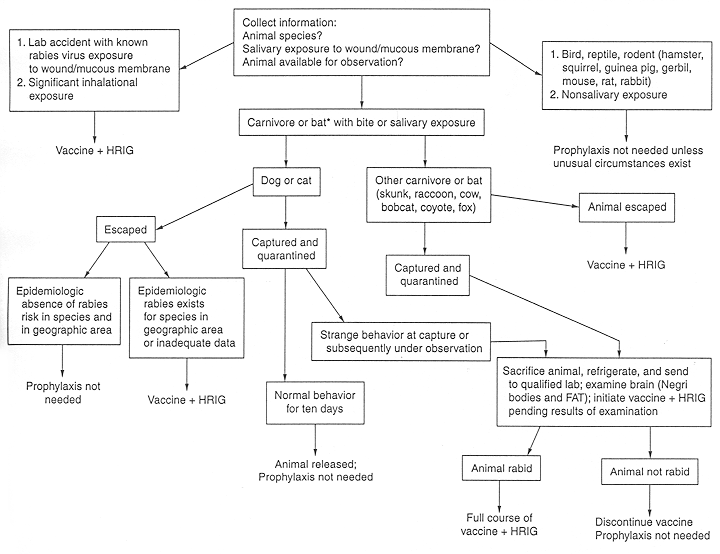
Rabies : Post-exposure Algorithm

Saturday, October 9, 2010

Algorithm for the therapeutic management of patients with venous ulcer

Algorithm for the diagnostic management of patients with chronic ulcer of L.L.

Tuesday, October 5, 2010

HYPERTHYROIDISM ALGORITHM

Topic is Hyperthyroidism and all the different types and how to distinguish between them:
Topics Include:
-Grave's Disease
-Silent Thyroiditis
-Subacute Thyroiditis
-Euthyroid Sick Syndrome
-Pituitary Adenoma
-Exogenous Administration

Labels: , ,

Friday, October 1, 2010

STOP Sepsis Bundle

Thursday, September 30, 2010

USMLE ALGORITHMS-SURGERY: CHEST TRAUMA

This ten minute clip talks about Chest Trauma including discussion of the following topics:
-Rib Fracture
-Traumatic Rupture of the trachea or bronchus
-Flail Chest
-Pulmonary Contusion
-Myocardial Contusion
-Traumatic Rupture of the Aorta

Written and narrated by a USMLE Expert. ENJOY!!

Labels: , , ,

Wednesday, September 29, 2010

USMLE ALGORITHMS: MENINGITIS

This algorithm is everything you need to know for the diagnosis and management of Meningitis for your exam. It is written and narrated by a USMLE Expert, and is to the point. All of Meningitis in less than 5 minutes.

Labels: , ,