Monday, December 27, 2010

Complications of Sickle cell disease

Medical mnemonic for the Sickle cell disease complications

SICKLE:

Strokes/ Swelling of hands and feet/ Spleen problems
Infections/ Infarctions
Crises (painful, sequestration, aplastic)/ Cholelithiasis/ Chest syndrome/ Chronic hemolysis/ Cardiac problems
Kidney disease
Liver disease/ Lung problems
 Erection (priapism)/ Eye problems (retinopathy)

Labels: , ,

Sunday, December 26, 2010

The lady between two majors


Bicipital groove: attachments of muscles near it

"The lady between two majors" :
Teres major attaches to medial lip of groove.
Pectoralis major to lateral lip of groove.
Latissimus (Lady) is on floor of groove, between the 2 majors.

Labels: ,

Friday, December 24, 2010

ABCD causes of BUN:creatinine elevation

BUN stands for blood urea nitrogen which measures the amount of urea nitrogen, a waste product of protein metabolism, in the blood. Urea is formed by the liver and carried by the blood to .........

Labels: , ,

Sunday, December 19, 2010

Causes of poor bilateral breath sounds after intubation

Think about DOPE
Endotracheal intubation: diagnosis of poor bilateral breath sounds after intubation
  1. Displaced (usually right mainstem, pyreform fossa, etc.)
  2. Obstruction (kinked or bitten tube, mucuous plug, etc.)
  3. Pneumothorax (collapsed lung)
  4. Esophagus

Labels: ,

Thursday, December 16, 2010

People have 3 types of tonsils

"PPL (people) have tonsils":
  • Pharyngeal
  • Palatine
  • Lingual

Labels: ,

Saturday, December 11, 2010

Popliteal fossa Mnemonic


Popliteal fossa: muscles arrangement

The two Semi's go together, Semimembranosus and Semitendonosus.
The Membranosus is Medial and since the two semis go together, Semitendonosus is also medial.

Therefore, Biceps Femoris has to be lateral.
Of the semi's, to remember which one is superficial: the Tendonosus is on Top.

Labels: ,

Friday, December 10, 2010

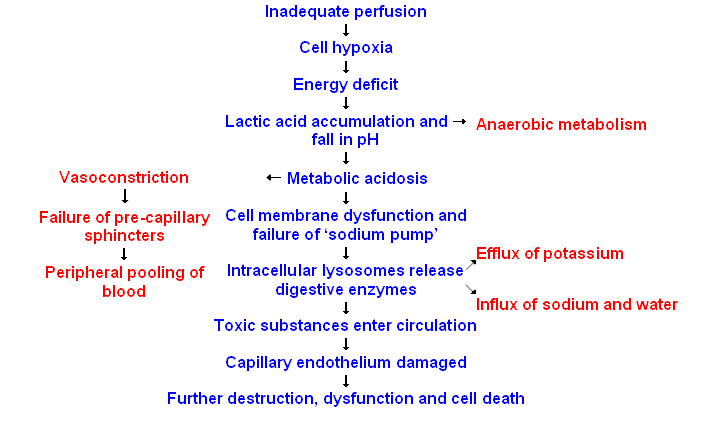
Compensatory mechanisms that 'save' organ blood flow

Effects of inadequate perfusion on cell function.

Heart compensatory mechanisms that 'save' organ blood flow during shock is collected in "Heart SAVER":
  • Symphatoadrenal system activation
  • Atrial natriuretic factor release
  • Vasopressin release
  • Endogenous digitalis-like factor release
  • Renin-angiotensin-aldosterone system activation

Labels: ,

Wednesday, December 8, 2010

Beta2 Adrenergic Receptor Mnemonic

Beta2 Adrenergic Autonomic Receptor of the Sympathetic Nervous System presented in a pictorial mnemonic format . Key Point: Beta2 expands. For Medical learning.

Labels: , ,

Tuesday, December 7, 2010

Rule of 2 of Diverticulum

Meckel's diverticulum details :
  • 2 inches long.
  • 2 feet from end of ileum.
  • 2 times more common in men.
  • 2% occurrence in population.
  • 2 types of tissues may be present.
· Note : "di-" means "two", so diverticulum is the thing with all the twos.

Labels: , ,

Friday, December 3, 2010

Chest radiograph: mnemonics checklist to examine


"Pamela Found Our Rotation Particularly Exciting; Very Highly Commended Mainly 'Cus She Arouses":
  • Patient details
  • Film details
  • Objects (eg. lines, electrodes)
  • Rotation
  • Penetration
  • Expansion
  • Vessels
  • Hila
  • Costophrenic angles
  • Mediastinum
  • Cardiothoracic Ratio
  • Soft tissues and bones
  • Air (diaphragm, pneumothorax, subcut. emphysema)

Labels: ,

Wednesday, December 1, 2010

Femoral triangle: arrangement of contents


It is collected in NAVEL:
· From lateral hip towards medial navel:
Nerve (directly behind sheath)
Artery (within sheath)
Vein (within sheath)
Empty space (between vein and lymph)
Lymphatics (with deep inguinal node)
· Nerve/Artery/Vein are all called Femoral.

Labels: ,

Monday, November 29, 2010

Mnemonic for Retroperitoneal structures list


This structures are collected in SAD PUCKER:

  • Suprarenal glands
  • Aorta & IVC
  • Duodenum (half)
  • Pancreas
  • Ureters
  • Colon (ascending & descending)
  • Kidneys
  • Esophagus (anterior & left covered)
  • Rectum

Labels: ,

Saturday, November 27, 2010

Names of B vitamins

"The Rhythm Nearly Proved Contagious":
· In increasing order:
  • Thiamine (B1)
  • Riboflavin (B2)
  • Niacin (B3)
  • Pyridoxine (B6)
  • Cobalamin (B12)

Labels: , ,

Tuesday, November 23, 2010

Agents for Spinal anesthesia


"Little Boys Prefer Toys":
  • Lidocaine
  • Bupivicaine
  • Procaine
  • Tetracaine


NOTES :
1-Lidocaine provides a short duration of anesthesia and is primarily useful for surgical and obstetrical procedures lasting less than one hour.

2-Tetracaine Vs Bupivacaine:Tetracaine and bupivacaine are used for procedures lasting 2 to 5 hours. Tetracaine appears to provide a somewhat longer duration of anesthesia and a more profound degree of motor block than does bupivacaine. On the other hand, compared with tetracaine, bupivacaine has been demonstrated to be associated with a decreased incidence of hypotension.
In addition, bupivacaine may be better than tetracaine for use in orthopedic surgical procedures since it appears to be associated with a lower incidence of tourniquet pain.

3-Vasoconstrictors can prolong the duration of spinal anesthesia of all three agents. However, the greatest duration is seen when vasoconstrictors are added to tetracaine solutions.

Labels: , ,

Sunday, November 21, 2010

Generalized skin hyperpigmentation: causes

"With generalized, none of skin is SPARED ":
  • Sunlight
  • Pregnancy
  • Addison's disease
  • Renal failure
  • Excess iron (haemochromatosis)
  • Drugs (eg busulphan)


Labels: ,

Saturday, November 20, 2010

Maxillary Artery Branches Mnemonic

"DAM I AM Piss Drunk But Stupid Drunk I Prefer, Must Phone Alcoholics Anonymous"


Deep auricular
Anterior tympanic
Middle meningeal
Inferior alveolar
Accessory meningeal
Masseteric
Pterygoid
Deep temporal
Buccal
Sphenopalatine
Descending palatine
Infraorbital
Posterior superior alveolar
Middle superior alveolar
Pharyngeal
Anterior superior alveolar
Artery of the pterygoid canal

Labels: ,

causes of coma, mnemonic

There are several medical causes of coma. One of the easiest ways to remember these causes is to use the mnemonic AEIOU TIPS:

* A - alcohol (overdose / withdraw / Wernicke's encephalopathy)
* E - epilepsy or exposure (heat stroke, hypothermia) or electrolytes
* I - insulin (diabetic emergency - high/low sugar)
* O - overdose or oxygen deficiency
* U - uremia (metabolic) or underdose
* T - trauma (head injury) or toxicology
* I - infection / inflammation
* P - psychosis or poisoning
* S - stroke / SAH / shock / syncope

Labels: , ,

Tuesday, November 9, 2010

Mnemonic for Indications of Bronchoscopy in a child

Indications for Bronchoscopy in Upper Airway Problems in Children use the mnemonic
"SPECS-R"

S - severity of the airway obstruction - Parents subjective impression of the severity of the problem.
P - progression of the obstruction.
E - eating or feeding difficulties.
C - cyanosis.
S - sleep apnea, especially with evidence of cor pulmonale.
R - radiologic abnormalities

See also this video

A PEANUT IN THE RESPIRATORY TRACT CAN CAUSE HUGE PROBLEMS.. WHEN IT IS NEGLECTED FOR WEEKS .... EVEN GREATER PROBLEMS

Labels: , ,

Saturday, November 6, 2010

My CHILD HAS PROBLEM

Down syndrome features: complete  Hi Yield [ID 865]
"My CHILD HAS PROBLEM!":

Congenital heart disease/ Cataracts
Hypotonia/ Hypothyroidism
Incure 5th finger/ Increased gap between 1st and 2nd toe
Leukemia risk x2/ Lung problem
Duodenal atresia/ Delayed development
Hirshsprung's disease/ Hearing loss
Alzheimer's disease/ Alantoaxial instability
Squint/ Short neck
Protruding tongue/ Palm crease
Round face/ Rolling eye (nystagmus)
Occiput flat/ Oblique eye fissure
Brushfield spot/ Brachycephaly
Low nasal bridge/ Language problem
Epicanthic fold/ Ear folded
Mental retardation/ Myoclonus

Labels: , ,

Thursday, November 4, 2010

Disease of bones,stones,abdominal groans and psychiatric moans

Primary hyperparathyroidism is described as "a common disorder of mineral metabolism characterized by incompletely regulated, excessive secretion of parathyroid hormone from one or more of the parathyroid glands"

The signs and symptoms of primary hyperparathyroidism are those of hypercalcemia. They are classically summarized by the mnemonic "stones, bones, abdominal groans and psychiatric moans".

* "Stones" refers to kidney stones, nephrocalcinosis, and diabetes insipidus (polyuria and polydipsia). These can ultimately lead to renal failure.
* "Bones" refers to bone-related complications. The classic bone disease in hyperparathyroidism is osteitis fibrosa cystica, which results in pain and sometimes pathological fractures. Other bone diseases associated with hyperparathyroidism are osteoporosis, osteomalacia, and arthritis.
* "Abdominal groans" refers to gastrointestinal symptoms of constipation, indigestion, nausea and vomiting. Hypercalcemia can lead to peptic ulcers and acute pancreatitis.
* "Psychiatric moans" refers to effects on the central nervous system. Symptoms include lethargy, fatigue, depression, memory loss, psychosis, ataxia, delirium, and coma.

The German description of the same symptoms is "Stein-, Bein- und Magenpein", literally "stone, leg, and stomach-pain".

In 1990, A National Institutes of Health (NIH) consensus panel defined renal stones in patients with primary hyperparathyroidism as an absolute indication for parathyroidectomy.
2-year-old woman  underwent parathyroidectomy for primary hyperparathyroidism. Sonogram of left kidney shows multiple calculi (arrows).

Labels: , ,